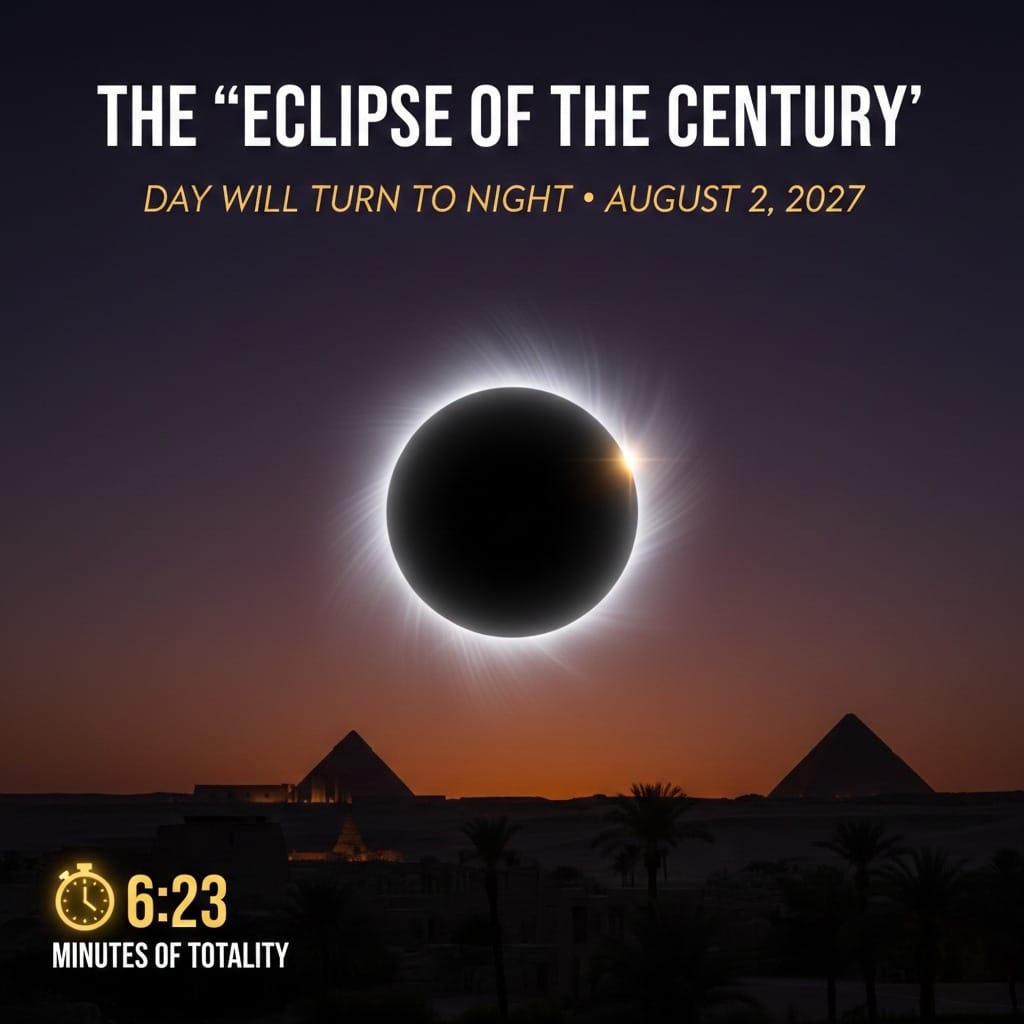
Sky lovers, grab your planners. Scientists now say it’s official: the so-called “Eclipse of the Century” has its date. That day? August 2, 2027. A special line-up in space will darken a wide stretch of ground below. For those underneath, daylight fades – slowly – as if night arrives early. This shadow lasts longer than any other total solar eclipse seen from land this century. Time itself seems to pause, just for a moment.
A single moment in 2027 will stretch longer than anyone has seen before. Four minutes of shadow in 2024 now seems brief by comparison. Darkness then will linger past six and a half minutes where it hits hardest. Few have witnessed such an unbroken stretch of night falling midday. That extra silence – second after second added – changes how we feel time.
A dark shadow sweeps across Earth when the Moon lines up just right, blocking the Sun entirely. Lasting longer than usual in 2027 – this one stretches because three space conditions line up at once.
A bit closer to us tonight, the Moon reaches perigee. Its distance shrinks just enough to catch the eye. Viewers will notice a slightly bigger disk overhead. Not every full moon gets this close. This one stands out without trying. Space lines up quietly, giving a fuller view.
Furthest from the Sun today, Earth takes its slowest path. The solar disk looks a touch more distant. A subtle shift, yet clear through careful eyes.
Built into the planet’s spin, near the middle line, sits a stretch where land moves fastest. This sprinting ground stretches time just enough beneath the moon’s swift dark sweep. There, on that belt around Earth, shadows crawl slower than they would elsewhere. Speed below lifts part of the show above.
The Path Of Totality Crosses Europe Africa And The Middle East
REGION
VIEWING LOCATION
Southern Europe
| Cádiz and Málaga (Spain), Gibraltar |
North Africa
| Tangier (Morocco), Oran (Algeria), Sfax (Tunisia), Benghazi (Libya) |
Egypt
| Luxor (Maximum Duration), Asyut, Siwa Oasis |
Middle East
| Jeddah and Mecca (Saudi Arabia), Sana’a (Yemen) |
Under golden sands, Luxor in Egypt stands ready for 2027. With six minutes and twenty-two seconds of total eclipse, few places match its stretch of darkened sky. Because winds stay calm and clouds rarely form, sunlight’s return feels almost predictable. Though distant from northern lands, travelers point southward now. When day turns to night mid-morning, dust and silence will speak first.
Folks who find themselves right in line get something beyond sight alone – a full-body change kicks in when the moment arrives
A hazy ring of pale glow, the Sun’s outer layer shows without tools. This faint halo appears right before dark.
Sunset spills across the edge of the world, stretching without break. Where one side fades, another begins anew. Colors climb the sky like slow-moving fire. From every angle, light lingers long after day should end.
Minutes pass, then the chill arrives – sharp, sudden, a shift you feel before you notice. Air loses warmth fast, like something switched off overhead. A few degrees gone, just like that, leaving skin tighter, breath visible. Not slow. Not gradual. Just colder, now.
Birds often go quiet when daylight fades fast, slipping back into nests as if night had fallen. A strange stillness takes over, their usual chatter replaced by unease. Shadows stretch suddenly, making some flutter home early. Light vanishes quicker than expected, throwing off routines built on sunrise and sunset. Instinct kicks in, guiding them to shelter before full dark arrives.
Safety warning: Keep your eyes protected. Special eclipse glasses are required – those meeting ISO standards – for every moment except totality. The only time viewing without protection works? When the sky goes fully dark. A brief window, just a few minutes long, allows naked-eye observation. Before and after that point, shielding matters.
That 2009 eclipse lasted just a bit longer – 6 minutes 39 seconds – but played out mainly above empty stretches of the Pacific. What makes 2027 stand apart is how its peak moment lands on reachable terrain. Following it, Earth won’t see another total eclipse matching that span until nearly a hundred years pass, deep into the next century.
Astronomy fans or newcomers alike will find the August 2027 eclipse shifts how you see your spot in space. Though brief, it pulls attention skyward, away from daily noise. One moment blends shadow and sunlight into something harder to forget. Because of timing, location matters more than usual. Still, those along the path share a quiet kind of awe. When darkness falls midday, familiar turns strange. After passes, light returns differently.
If you’ve been scrolling Instagram or TikTok this week, you’ve likely seen these stunning hyper-realistic portraits: a beautiful woman in a luxurious […]